

Conditions affecting the retina and vitreous humour
Our retina specialist takes charge of treating conditions affecting the retina and vitreous.
- Vitrectomy
Floaters
What are floaters?
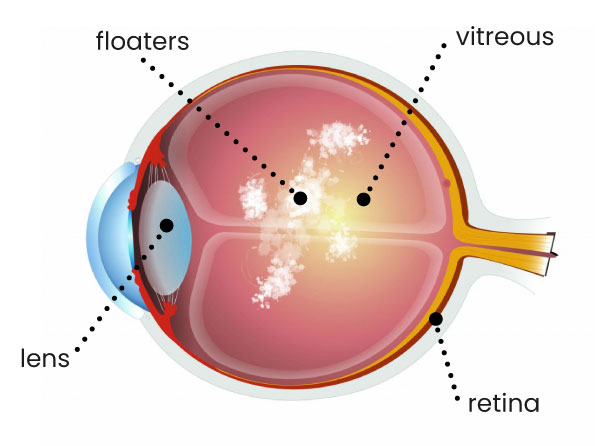
Do you see black, drifting specks, dots or threads in your field of vision, especially against a light background such as a screen or a clear sky? Then they may well be floaters.
These specks drift slowly along with your gaze and keep returning to their starting position. They can occur in one or both eyes. Floaters are particles that float in the vitreous, the jelly-like fluid that fills your eye. They are usually harmless and simply a nuisance, but they can sometimes point to another eye condition. A check-up with your ophthalmologist is therefore advisable.
- Black, drifting specks, dots or threads in your field of vision
- More noticeable against bright backgrounds, such as a screen, a white surface or a clear sky
- Specks that move along with the direction in which you look
- In one or both eyes

During a preliminary examination, your eye doctor will look into your eye to assess the retina and the vitreous. To do so, the pupil is dilated as far as possible with drops. Driving afterwards is not possible for at least three hours. Sometimes the retina cannot be assessed properly. In that case, we will use an ultrasound device to see whether your retina has become detached. This examination is painless and safe.
If the cause of the floaters is a posterior vitreous detachment, then no treatment is needed or possible. The floating spots will become less annoying over time, but they usually do not disappear completely. Flashes of light generally stop on their own or if the vitreous no longer pulls away from the retina. Sometimes, floaters are an indication of an underlying eye condition that requires further treatment.
In extreme cases, the vitreous opacities have to be removed by an operation, a vitrectomy, in which the entire vitreous body is taken out of the eye.

Age-related macular degeneration (AMD)
What is age-related macular degeneration?
Age-related macular degeneration (AMD) is a condition affecting the central part of the retina, the macula, with which we perceive detail. It is often described as wear or ageing of the retina. AMD affects your vision and can be linked to factors such as heredity, age and environmental influences.
- Less sharp or blurry vision up close
- Dark spots or dots in the centre of your image
- Distortion of the image, especially of straight lines
- Faded colours
- Reduced night vision
Injections
The main treatment for wet AMD consists of anti-VEGF injections, such as ranibizumab, bevacizumab and aflibercept. These curb the abnormal growth of blood vessels and reduce leakage in the eye. After a monthly initial injection, we set the frequency of the follow-up injections based on the check-ups, often four to six times a year. The injections work well but do not fully restore your vision: above all, they stabilise the condition. Regular check-ups with the ophthalmologist remain essential.
Photodynamic therapy (PDT)
In certain cases of wet AMD, photodynamic therapy is an option. We inject a light-sensitive medicine, verteporfin, into the bloodstream. We activate that medicine with laser light, after which it targets and destroys the abnormal blood vessels in the macula. PDT is used less often nowadays, as anti-VEGF injections have proved more effective.
Combination therapy
Sometimes a combination of treatments is appropriate, for example anti-VEGF injections together with photodynamic therapy, to tackle different aspects of the condition at once and optimise the result. We apply combination therapy only exceptionally.
Laser photocoagulation
Laser photocoagulation is used less often today but may be considered in specific cases of wet AMD. In the past, laser was used to seal off or destroy the abnormal blood vessels in the macula. Usually the treatment targets smaller, clearly defined areas of abnormal vessels outside the central field of vision.
Laser is sometimes used to reduce drusen and so prevent a progression to wet AMD, although there is still much debate about this.
Diabetic retinopathy
What is retinopathy?
With diabetes, the blood vessels in your retina can become damaged. We then speak of diabetic retinopathy. This damage from abnormal or leaking blood vessels can lead to poor sight and even blindness, which is why regular check-ups with your ophthalmologist are very important.
- Less sharp vision
- Blurred vision
- Spots or drifting patches in the field of vision
- Distortion of the image, especially of straight lines
With a laser treatment, our ophthalmologists can effectively seal the leaking blood vessels. This treatment usually takes half an hour. It can slow and sometimes stop the decline in your vision, but it does not cure the retinopathy, as the quality of the retina can keep deteriorating. The laser treatment therefore sometimes has to be repeated several times.
Diabetic patients have an increased risk of tears and detachment of the retina. We seal tears with laser surgery, while a retinal detachment requires an operation.