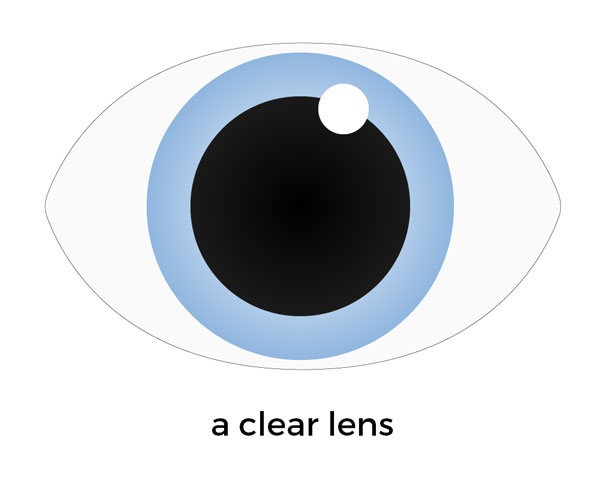
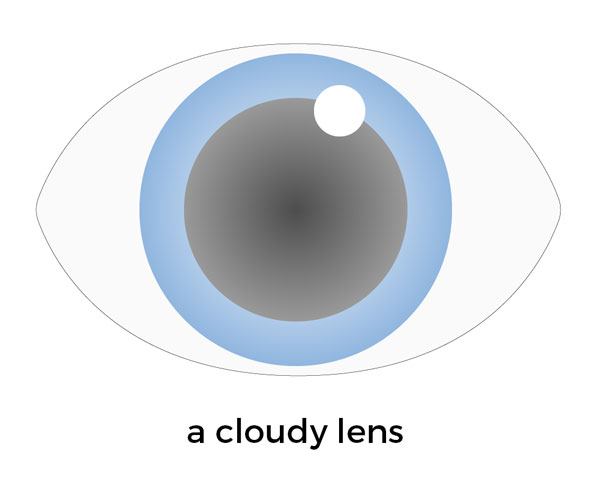
Cataract is a clouding of your own lens. Normally this lens projects a sharp image onto the retina at the back of your eye, so you see clearly. When the lens turns cloudy, your vision clouds over too. In most cases, cataract is age-related and mainly affects people over 60, although it can sometimes appear earlier. How quickly it progresses varies from person to person. As soon as it starts to bother you, cataract surgery comes into the picture.
Symptoms of cataract
Blurred vision
Double vision
Changing vision after the age of 60, for example suddenly being able to read without glasses again
Treatment of cataract
The only lasting solution for cataract is a procedure in which we replace the clouded lens with a clear artificial one. This can be done under anaesthetic drops, and there are various techniques for removing the clouded lens. A cataract procedure with lens replacement is the most frequently performed operation in Europe.
The whole procedure takes less than 15 minutes. We work with the latest, advanced equipment for an optimal result, and the incisions are so small (less than 2.5 mm) that stitches are not needed.
Phaco-emulsification
Through a small incision, we insert a hollow probe that vibrates at high speed. This breaks the affected lens into small fragments, which the probe immediately suctions away. The back part of the lens capsule remains intact.
Inserting the lens implant
Through that same incision, we then slide in a folded implant lens and place it in the empty lens capsule.
New, clear lens
Once the new, clear artificial lens is in place, we remove the probe. Thanks to the tiny incision, stitches are unnecessary.
Int-depth examination and the right lens implants for you
A thorough assessment is essential to determine the right treatment and the most suitable implant lens. This examination takes a good two hours, and because we administer pupil-dilating drops, we recommend bringing someone to accompany you.
Based on the results, your expectations and your lifestyle, you choose the most suitable implant lens together with your ophthalmologist. Our doctors fit every available type of lens.
Standard, monofocal lens
A monofocal implant lens corrects most of your distance vision. After the operation, most patients manage without glasses for distance. For anything within one and a half metres (reading, handicrafts, cooking, eating, price tags, your phone, the car dashboard) glasses are still needed. With monofocal lenses, monovision is also possible: we set one eye for distance and the other for near.
Multifocal lens
Multifocal lenses give a clear image at several distances at once. As a result, after the procedure you usually no longer need extra glasses for reading or other activities at varying distances, and that for the rest of your life. Some patients do need a little time to adjust, as the brain has to get used to the new situation. These lenses also require sufficient light to allow good near vision.
Toric lens
Irregularities in your cornea, such as a cylinder or an abnormal sphericity, can be offset with a toric implant lens. Both monofocal and multifocal lenses come in this personalised version.
During the assessment, you get a clear picture of the costs of your specific treatment. The final price depends mainly on the lens chosen, and part of the procedure is reimbursed by the health insurance.
At the consultation, we explain everything: how a cataract procedure works, how to prepare and what aftercare is needed.