

Deformation of the cornea
(Keratoconus)
What is keratoconus?
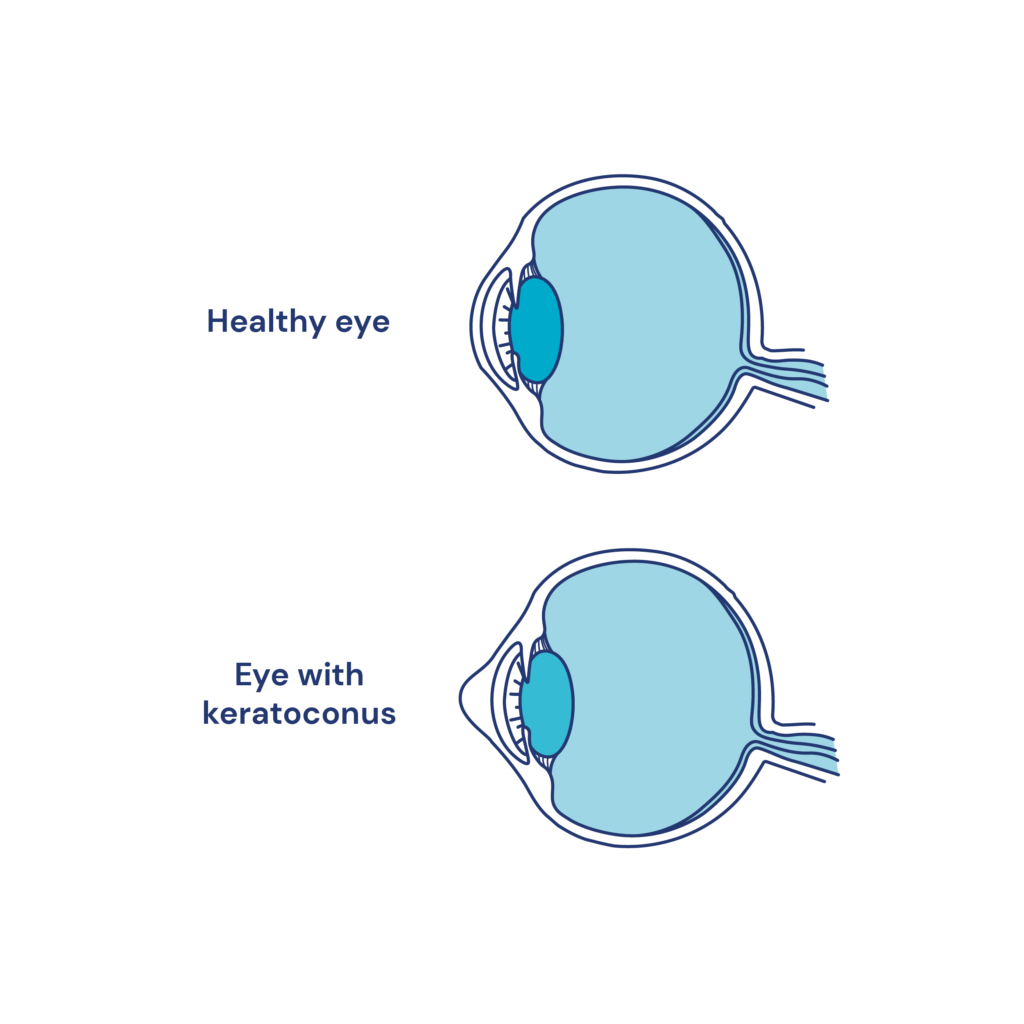
Keratoconus is a condition that affects the cornea and makes it deform asymmetrically. The cornea is the transparent outer layer of your eye and is normally nicely round. With keratoconus, its structure weakens, so it loses its round shape and becomes more cone-shaped. Because of this gradual deformation, the cornea thins and your visual acuity declines. In rare, advanced cases, the cornea can even turn cloudy or tear.
Symptoms of keratoconus
- Distorted vision
- Sensitivity to light
- Light scattering
- A cylinder (astigmatism) and distorted images
- Possible nearsightedness (objects or people in the distance look blurry)
- Seeing a ‘fog’ (at an advanced stage)
Treatment of keratoconus
We make the diagnosis through several examinations. These have a dual purpose: to map the asymmetric shape of the cornea precisely and to monitor how it changes over time. We determine the prescription with which you see most sharply, measure the curvatures of the cornea and capture it three-dimensionally (topography). On this basis, your ophthalmologist can detect any further decline early.
Treatment of keratoconus has two goals:
- Improving your visual acuity
- Slowing or stopping further decline
Improving visual acuity
With mild keratoconus, your vision can often be corrected well with glasses or ordinary contact lenses. In more pronounced cases, special scleral contact lenses are needed to see sharply. Our centre has the in-house expertise to fit these special lenses to measure.
Slowing or stopping the decline
It has been shown that rubbing your eyes deforms the cornea further. Avoiding rubbing as much as possible is therefore essential. Your ophthalmologist will also treat any underlying causes of itchy eyes.
In some cases, avoiding rubbing your eyes is not enough to halt the decline. In these situations, your ophthalmologist will discuss with you the possibility of treatment with UV crosslinking or intracorneal rings.
What treatments do we offer?
- UV crosslinking is a safe and effective treatment that slows the progression of keratoconus by strengthening the collagen fibres in the cornea. The procedure takes about half an hour and is performed under anaesthetic drops. We remove the outer layer of the cornea, treat the eye with vitamin B2 drops and expose it to ultraviolet light. Afterwards, you care for your eye with eye drops and ointment to prevent complications.
- Intracorneal rings are a surgical treatment in which we insert small rings into the thickness of the cornea, after creating an intracorneal tunnel with the laser. The rings are placed where the cornea bulges, to flatten it there and so reduce the irregularity, and therefore the astigmatism. They are made of PMMA plastic (Keraring, ICR, …) or of human corneal collagen (CAIRS). The procedure is performed under anaesthetic drops and takes about thirty minutes.
How much does the treatment of keratoconus cost?
During the consultation, we go through the total cost of any treatment in detail. For an initial overview, you can visit our pricing page.